
How to Introduce High Schoolers to Diplomacy
Failure to do so will doom U.S. global power to an even darker future than the one chartered by the Trump administration.

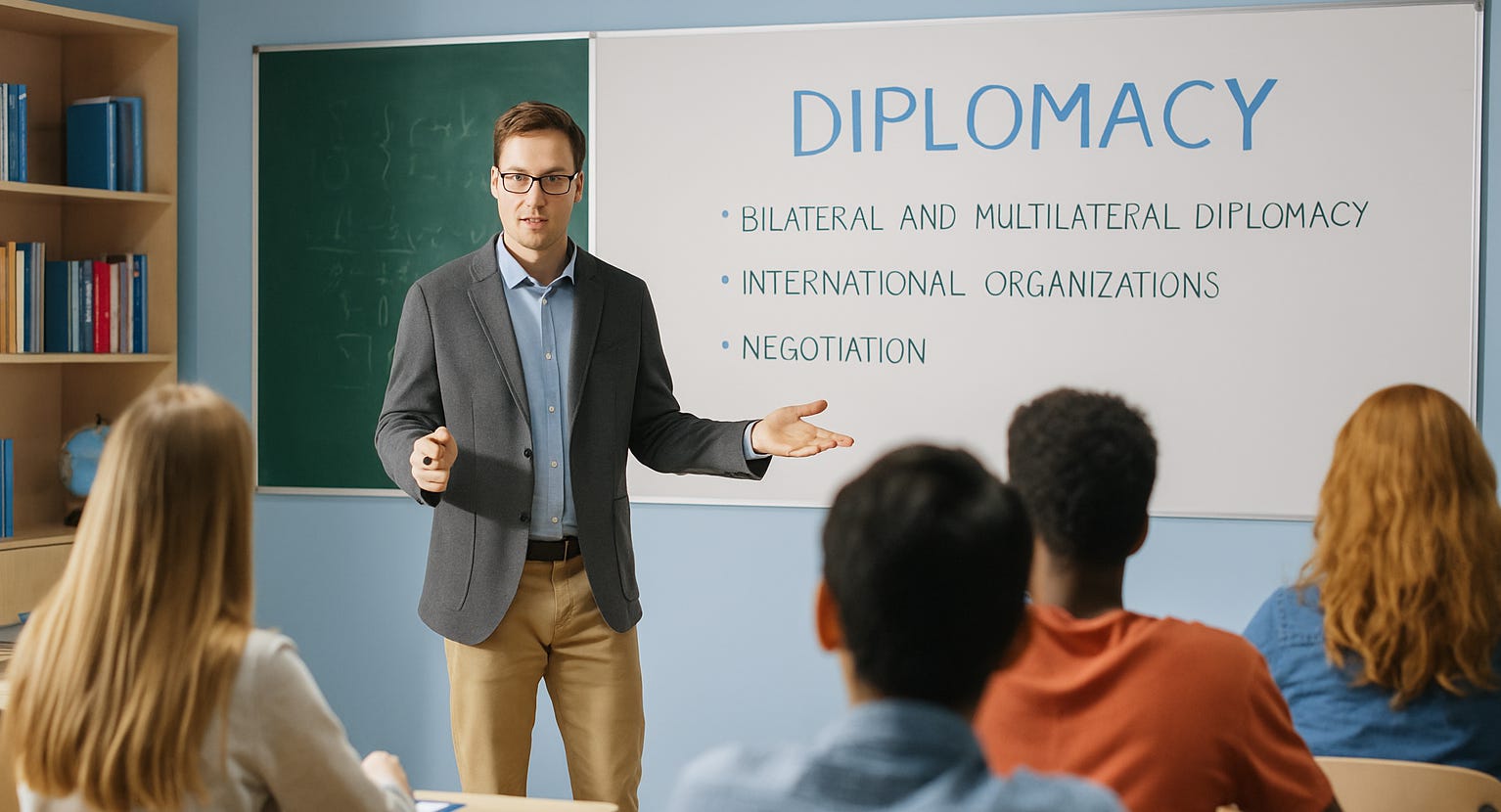
I have a dream. In it, all high schools in the United States introduce the concept of diplomacy to their students. As I’m less of a dreamer than a realist, I don’t expect young Americans to learn diplomacy skills, even though those are also essential life skills. Just being aware that diplomacy exists and understanding what it means would be a spectacular achievement.
This may be a dream, but unless it becomes a reality soon, the future of U.S. global power is likely to be much darker than the path the Trump administration has already set. Yes, even a small innovation in education takes years to implement, but we have to start somewhere — and it’s not as if anything in the administration’s approach to the world will change, so the best we can do in the next three and a half years is prepare for life after Trump.
Having a citizenry that understands even the basics of how diplomacy works might help restore at least some of the U.S. influence squandered in the past six months. The unprecedented power the United States built in the decades after World War II is likely lost forever. The administration’s bullying and heavy-handed tactics toward friends and foes alike shouldn’t fool anyone into confusing bluster with actual power, as I pointed out in June. The world is horrified by its incompetence, cruelty and corruption.
Knowing better
Last month, I argued that the American public is unable to recognize that the administration is destroying the U.S. diplomatic capacity and influence, because it doesn’t understand what diplomacy is about. For that I blamed the failure of the country’s education system.
Most Americans graduate from high school without ever hearing the word “diplomacy” in a classroom. They enter the real world knowing almost nothing about how their country interacts with the rest of the world — and how those relationships affect their own lives.
I have no illusions that my dream is a very tall order, especially in a country with no single national authority over the K–12 curriculum — it’s under a mix of state- and local-level control, and sometimes school-level discretion. Most of the 13,000 public school districts don’t even teach geography as a separate subject, though some fold it into social studies, usually as part of history lessons and with minimal coverage.
Training the teachers
Social studies — and particularly government classes — would be the logical home for lessons introducing students to diplomacy. Currently, there are no trained teachers, but the Washington International Diplomatic Academy, which I lead, is ready to help by both designing programs and conducting the training. Our instructors are some of the most experienced career ambassadors.
We don’t expect teachers to pay, so either their schools or districts would have to finance these programs or outside funding would be needed. The cost would be minimal for a midsize foundation, yet it would certainly make a huge difference. If you have ideas, contact us.
What would the training include? Teachers don’t need to know the intricacies of the Vienna Conventions on Diplomatic and Consular Relations. But they must grasp basic concepts — such as bilateral and multilateral diplomacy, the role of international organizations, the difference between formal and informal diplomacy — and be able to make them relevant to students’ lives.
Through both content and pedagogy, we can help educators understand and teach fundamentals like empathy, active listening, negotiation, cross-cultural communication, resolving conflicts, advancing interests and forging lasting agreements. That will prepare students not only for careers in international affairs, but also for leadership in business, law, public service and many other fields.
Key life skills
Diplomacy lessons can also help develop critical thinking. Studying real-world cases shows students how history, culture, economics and politics intersect. They learn that the world is complex, that problems rarely have quick fixes, and that understanding another party’s perspective is essential to reaching a solution.
Our training would blend three elements:
Core knowledge: A crash course in the fundamentals of diplomacy, its role in national security and its impact on the global economy. This would give teachers the factual grounding to explain why diplomacy matters and how it works in practice.
Practical exercises: Simulations and role-playing that allow teachers to experience negotiation and conflict-resolution firsthand. These exercises would be adaptable for classroom use, so teachers can recreate them for their students.
Curriculum integration: Guidance on how to incorporate diplomacy into existing subjects such as history, civics, social studies and even literature.
Overcoming hurdles
Introducing diplomacy into high schools won’t be easy. Curricula are already crowded, and some may argue that diplomacy is too complex or “political” to teach to children.
In reality, diplomacy is a process, not a partisan position. Teaching students how countries communicate, negotiate and solve problems doesn’t require endorsing a particular policy. It requires explaining how decisions are made, how conflicts are resolved, and what the consequences are when they are not.
Training teachers to teach diplomacy is not just about creating a more informed public. It’s about cultivating the next generation of problem-solvers. Imagine a future in which every young American has at least a basic grasp of how to navigate conflicts, find common ground and build partnerships. Imagine a political culture in which debate is grounded in understanding rather than suspicion.
The payoff would be enormous — for our foreign policy, our economy and our social fabric.
Both The Diplomacy Notebook and The Diplomacy Podcast are free, but you can show your support by making a donation to help us continue to produce unique and timely content.
Nicholas Kralev is the founder and executive director of the Washington International Diplomatic Academy, and a former Financial Times and Washington Times correspondent. His books include “Diplomatic Tradecraft,” “America’s Other Army” and “Diplomats in the Trenches.”
Thank you for imagining the power of education Nicholas. Diplomacy has its place in the hearts and minds of our youth!
Your wish is my command!! At Global Santa Fe we are already teaching Diplomacy to High School Students - using some of the materials created by the National Museum of American Diplomacy. We have 9 diplomacy modules (2 hours), each followed by a session with an expert in that skill (1.5 hours) i.e. Composure (former Ambassadors, Judges, local civic leaders, etc) for an intergenerational exchange - every student asks a question. Culminating this program is an opportunity to practice these skills while on an international exchange (10 days) - we focus on Santa Fe's Sister Cities. From our M&E, which is mostly qualitative of course, we are thrilled with the transformational results. Students 100% understand how DIPLOMACY can help them navigate their current lives as well as imagine how it will help in the future. We should talk!! We WANT to share our system and the curriculum we have developed!! LOVE THIS STORY!! (yes, I just yelled!!)