
Rubio's Plan for a Dictator's Foreign Service
New reforms open the door to ideological screening in hiring and indoctrination in training.

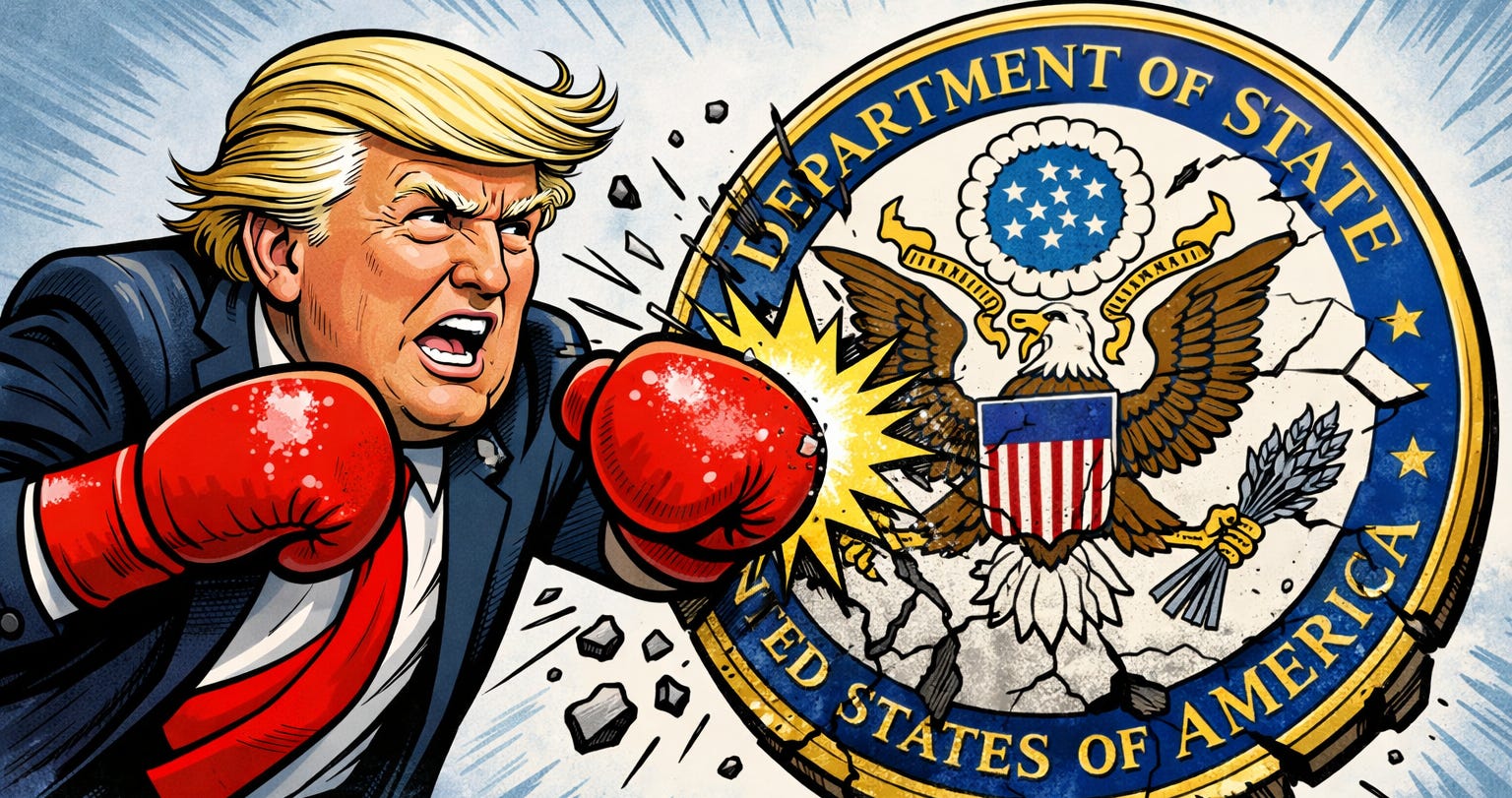
I’ve spent much of my career trying to elevate professional diplomacy so it’s taken as seriously as defense and intelligence. I’ve also advocated for meaningful reforms to the U.S. Foreign Service — especially preparing new diplomats to do their jobs before entering the field, as opposed to the longtime practice of learning on the job.
For years, I’ve criticized both Democratic and Republican administrations for failing to undertake such reforms and settling for superficial changes. Given the first Trump administration’s track record, I had no illusions that Secretary of State Marco Rubio’s attempts to remake the Foreign Service would make things any better.
Regrettably, Rubio’s plan for hiring and training new career diplomats, which was unveiled last week, makes things worse. The plan moves the service in the opposite direction from where it needs to go. It also comes as the administration seeks to reduce the State Department budget by 30 percent — the largest cut of any agency.
Despite claims that they will “modernize” the service and “align” the hiring process and initial training “with the skills and expertise needed to successfully represent the interests of the American people,” the changes do neither. Those phrases are a smokescreen. In practice, the reforms will make the service less professional and more ideological — closer to an authoritarian instrument than a democratic institution.
The written exams: Logical or ideological?
Let’s start with the selection of Foreign Service officers. The first phase of the highly competitive and lengthy process — a multiple-choice written exam — has long tested general knowledge of U.S. history, government, geography and basic economics. It has never been a reliable predictor of diplomatic performance, but it serves a limited screening purpose.
Rubio’s decision to add “questions on American history and logical reasoning” is puzzling. History has always been part of the exam, and “logical reasoning” is vague and not exactly the test’s purpose. It sounds less like a skill and more like a coded preference for a particular way of thinking — not “logical” but ideological.
These additions, which were actually introduced last fall, supposedly replaced questions “intended to test alignment with the diversity, equity and inclusion agenda.” In reality, no such questions existed on the test — unless one considers the history of the civil-rights movement to fall in that category.
The second stage of the process has been transformed more dramatically. It used to evaluate candidates holistically — education, professional experience, language skills and other qualifications — alongside short essays. That entire review has been eliminated and replaced with another written exam — essay-style responses to two questions, meant to test applicants’ “ability to think critically and write clear prose.”
This opens the door to ideological screening. Essay prompts can easily be designed to reward conformity and penalize dissent. Without transparency about the topics or evaluation criteria, there is no safeguard against such misuse.
Reaching back to the past
The removal of the qualifications review isn’t new — so much for “modernization.” It revives a “blind process” from the 1990s, which was more egalitarian in theory. Secretary of State Colin Powell ended it in the early 2000s, because it ignored valuable experience — military service, Peace Corps work and foreign language ability — that the Foreign Service needs.
It’s not difficult to see that the Trump administration is reverting to a three-decade-old approach to prevent race from being a factor in the selection process. Otherwise, it could have added the second written exam without cutting the qualifications review. The thing is, the assessors who conducted that review had no access to applicants’ race. In theory, candidates could mention it in their short essays, but few ever did.
It’s true that the Obama and Biden administrations made increasing diversity in the Foreign Service a priority — as did the George W. Bush administration, though to a lesser extent. Their efforts focused largely on recruitment, encouraging minority students at colleges and universities to consider diplomatic careers. Rubio has since dismantled that effort, shutting down the recruitment office and firing all its staff.
The Biden administration also decided to delay the initial elimination of applicants until after the qualifications review, rather than having one round after the written test and another after the review. Its reasoning was that many candidates, including minorities, didn’t do well on multiple-choice tests but possessed experience and skills that could help them succeed in the oral assessment, the third phase of the process.
Rubio could have restored the old approach, but he chose instead to scrap previous qualifications altogether. As a result, a tiny fraction of all candidates will move on to the oral assessment based only on their test scores and essays, narrowing the pipeline in a way that magnifies the influence of subjective judgments.
The oral exam: Theory trumps practice
The oral assessment has traditionally included activities simulating embassy work, such as drafting a memo and participating in a team exercise, as well as an interview with a panel of three examiners.
Rubio’s plan promises to “refocus on testing substantive knowledge of U.S. foreign policy concepts, diplomatic history and negotiation skills.” No details have been provided, and there is no information about the new process on the State Department’s careers website. But the focus seems to be shifting from active skills to passive knowledge.
“Foreign policy concepts” and “diplomatic history” can easily be tested in the first two phases. The oral assessment should be used to measure what matters most in daily diplomatic practice: performance under pressure, communication, analysis, judgment and collaboration.
It’s striking that Rubio’s plan mentions only negotiation skills, because they are the most difficult to test in such a setting and within limited time. I’m talking about real diplomatic negotiation, not transactional dealmaking. Its inclusion alongside “foreign policy concepts” and “diplomatic history” reads less like a serious design choice and more like an attempt to balance an otherwise theoretical focus.
This emphasis on theory is the most troubling aspect of Rubio’s reforms — in both the examination process and the training of new officers. Their orientation course at the Foreign Service Institute has never included enough practical skills to prepare them properly for their jobs.
“Tradecraft” isn’t what it seems
Things are about to get even worse, as new officers will now receive “content on policy and tradecraft, which includes lectures on diplomatic history and America First foreign policy,” and they will “engage with international relations theory.”
This betrays a profound lack of understanding of what “tradecraft” means. It’s not theory. It’s a set of practical skills, duties and responsibilities required in the daily work of modern diplomacy. It’s not clear who at the State Department came up with that formulation, but they should have read my book “Diplomatic Tradecraft.”
There are hundreds of universities that teach diplomatic history and international relations theory, and even more books on these subjects. But that’s very different from diplomatic practice. Although such academic degrees provide a useful foundation, they are no substitute for practical training.
Why waste time in a five-week course with material easy to learn in academia and on your own, instead of teaching skills that are actually needed in a diplomatic career and almost impossible to acquire elsewhere? Well, except at the Washington International Diplomatic Academy, which I lead.
The inclusion of “America First foreign policy” is especially revealing. It suggests that training won’t just inform and teach, but shape how officers are expected to think. That’s not professional education. It’s indoctrination.
Almost every administration tries to adjust hiring and training to align with its policy priorities, but Rubio’s changes go much further than usual, inflicting serious damage on the diplomatic profession.
The United States needs a Foreign Service that is skilled in diplomatic practice, grounded in reality and capable of separating national interests from partisan ones — not one molded to reflect the ideological preferences of any administration.
Both The Diplomacy Notebook and The Diplomacy Podcast are free, but you can show your support by making a donation to help us continue to produce unique and timely content.
Nicholas Kralev is the founder and executive director of the Washington International Diplomatic Academy, and a former Financial Times and Washington Times correspondent. His books include “Diplomatic Tradecraft,” “America’s Other Army” and “Diplomats in the Trenches.”
Who can push for better than what Rubio designs???
Thanks for laying it all out. It makes me sad, though.